
EXPERT GUIDE · COURSE PROPOSALS
How Do I Propose a Course for a College’s Continuing-Education Catalog?
Begin with the department that would offer the course. Its current instructions tell you which route to use, what to prepare and where the proposal goes.
For experts considering a college continuing-education proposal

To propose a continuing-education course to a college, find the relevant department’s instructor or course-proposal page, read the current form and accompanying instructions, then prepare the material that route requests. A catalog listing is a possible later decision; it is not something you obtain by uploading a finished course to any available contact form.
The steps below are our preparation recommendations. The college examples show why the actual instructions matter. They do not create a common application standard or establish that a college will consider, approve or offer your course.

01 · LOCATE THE ROUTE
Find the department and the kind of offering.
Start on the college’s own website. Look for continuing education, extension, community education or the program area closest to your subject. From there, look for teaching opportunities or course proposals. Check that the instructions concern the audience and format you have in mind.
- Check the current catalogLook at the learners addressed, the subjects offered and how classes are described. Note where your idea might fit and what you still need to ask.
- Identify the recipientSave the department page and its named submission route. A general admissions form may serve a different purpose.
- Identify the proposal categoryAdult enrichment, youth programming and professional learning may have separate instructions. Use the category the department identifies for your idea.
For example, Cabrillo Extension’s teaching page asks prospective instructors to review its catalog and provides separate adult-enrichment and youth proposal links. Its linked adult form introduces an open-enrollment proposal and distinguishes new instructors from some returning instructors. Those routing distinctions belong to Cabrillo; check the equivalent instructions at your target college.

02 · NAME THE WORK
Clarify whether you want to teach or develop a program.
Before preparing a packet, write one sentence about the opportunity you are seeking. Do you want to teach a class through a particular college? Or do you want help turning your expertise into a program for possible institutional review and distribution? Those intentions can involve different work and different recipients.
- A teaching proposal
- Read what the specific college asks the prospective instructor to prepare, teach and provide. Confirm the role instead of assuming that submitting a subject idea includes course production.
- A development partnership
- Clarify the proposed writing, design, production and review work, who would do it and what agreement would cover it.
- A finished outside course
- Ask whether the department has a suitable route for considering an existing course. Do not assume its instructor application covers that arrangement.
SkillShiftEd’s partnership process guide describes fit discussions, development, preparation and possible college distribution. Project work needs its own agreement, and institutions make their own decisions. That guide can help you explore the development route; it does not replace a college’s proposal instructions.

03 · FOLLOW THE ACTUAL INSTRUCTIONS
Read the whole form before drafting the answers.
Open the form and any linked packet or handbook. Check which questions are required, what attachments are requested, whether you are using the current version and how the material must be submitted. If instructions appear to conflict, ask the department which version applies before relying on one.
- COCC: a public proposal formCentral Oregon Community College’s form asks about the course description, learning outcomes, intended audience, delivery preference, community need and the proposer’s relevant experience. Read its prompts in context; this is COCC’s form.
- CWU: a category-specific packetCentral Washington University’s linked non-credit proposal packet asks for course and scheduling details and supporting documents. Its documentation section calls for a résumé, a syllabus and the signed handbook acknowledgment. It also includes a learner-outcome, activity and assessment form.
Read the COCC form, the CWU proposal page and the CWU non-credit packet directly. They are examples of different routes, not a combined checklist. Read any acknowledgment before signing it; a summary of the requested attachment does not substitute for the document itself.
Use the department’s current proposal deadline and follow-up instructions. A published date or review interval at one college says nothing about another college’s schedule. Avoid planning a launch around an assumed acceptance date.
04 · MAKE THE IDEA CONCRETE
Prepare answers that make the learning understandable.
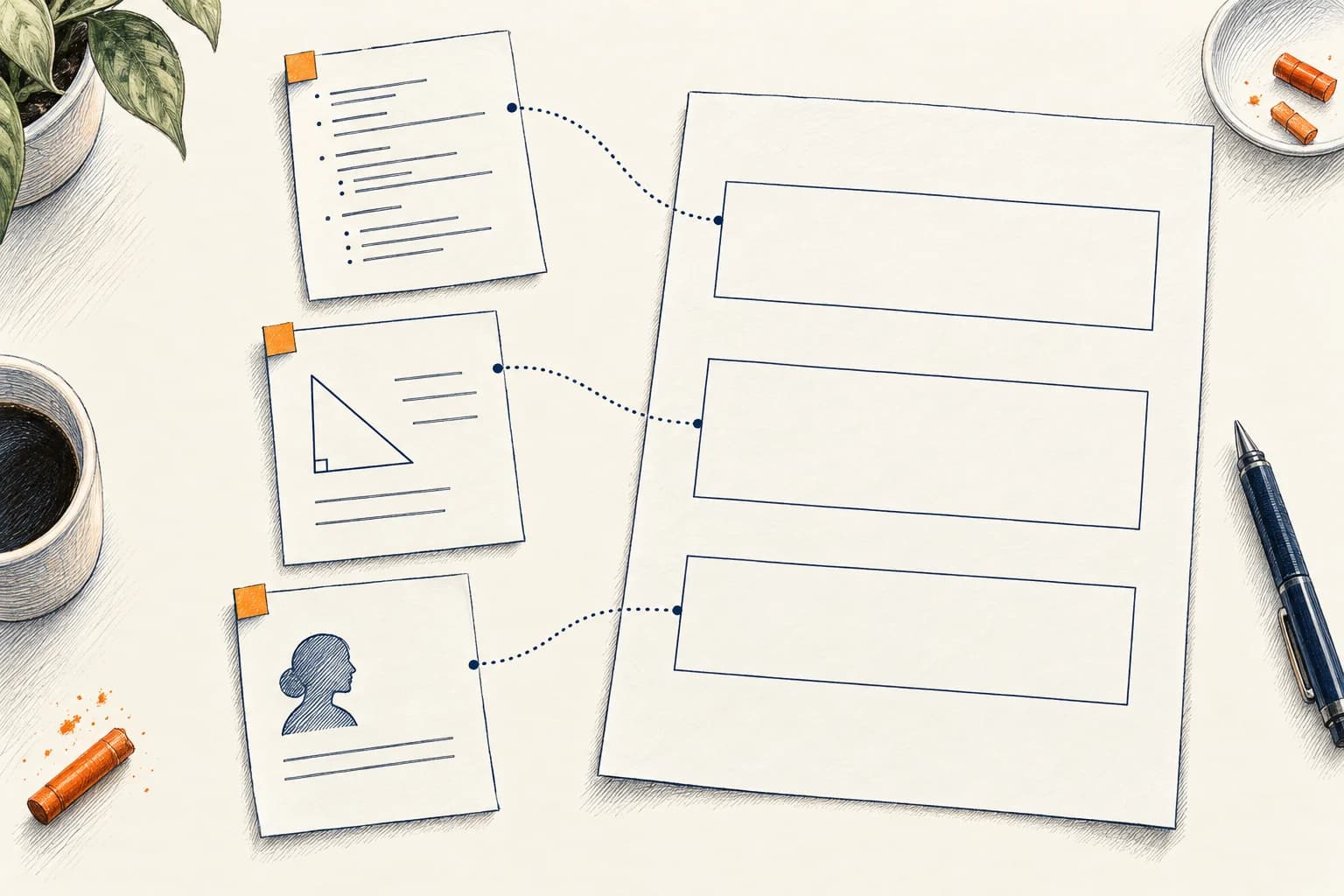
Once you know what the department requests, collect the relevant material. Keep each answer tied to the intended learner and the work you can actually teach. Describe your experience accurately and separate existing material from work you still plan to create.
- The learner and purpose
- Explain who the idea serves and the situation in which the learning would be useful.
- The learning itself
- Name a concrete action the learner would practice. Use a representative activity to explain the course when the form asks for that detail.
- Your contribution
- Connect relevant subject and teaching experience to the proposed work. Keep any qualification claims supportable.
- Delivery questions
- Identify practical needs the form asks about, such as space, equipment or availability. Bring unresolved details back to the department.
For an invented example, a photographer might propose a class in using window light for small objects. “Arrange a subject and reflector, then compare two resulting images” explains a learning activity more clearly than “take your photography to the next level.” It does not prove demand or promise that this topic will be accepted. For help with the wording, see our course-description guide.

05 · SUBMIT WITH CONTEXT
Use the stated route and keep the next decision clear.
Before submitting, compare your packet with the current instructions. Include the requested documents, use the specified route and retain a copy of what you supplied. Follow the department’s directions for questions or follow-up. If a detail needs an answer before you can complete a required field, use its published contact route to clarify it.
- What have you submitted?Keep the course title, department, version and submission date together in your own records.
- What remains undecided?Distinguish a question about fit from an agreement to develop, teach or offer the course.
- What happens next?Use the department’s stated process. If none is clear, ask how it will communicate a decision or request for more information.
Submission alone does not establish catalog placement. Keep public descriptions aligned with what has actually been confirmed. Our college-ready guide explains preparation for review; it does not grant institutional approval.
Choose the college and program area you want to approach. Open its current proposal route, then note what is required, what you already have and what needs clarification.
Considering development help? Read the partnership guide
06 · QUESTIONS & ANSWERS
A few practical questions.
Where do I submit a continuing-education course proposal?
Use the route published by the relevant college department for the intended offering. Start with its continuing-education, extension or community-education pages, then find the current teaching or proposal instructions. Confirm the recipient if the route is unclear.
Do I need a finished course before I propose one?
Read the specific proposal requirements. An initial idea form and a detailed submission packet can ask for different material. Do not assume that a college accepts a brief idea, or requires every lesson to be complete, without checking its instructions.
Can I send the same packet to every college?
Use each department’s current instructions to decide what belongs in its packet. You may have useful source material to draw on, but proposal categories, requested attachments and submission methods need to be checked separately.
Does submitting a proposal mean the course will appear in the catalog?
No. Submission and catalog placement are separate. Follow the department’s process and describe the course’s status only as far as it has been confirmed.
Is a SkillShiftEd inquiry the same as applying to teach at a college?
No. A SkillShiftEd inquiry explores a possible development and distribution partnership. A college’s instructor-proposal route is governed by that department’s instructions. Clarify the work you want to discuss and use the appropriate route.